Thursday, March 12, 2026


Friday, March 6, 2026
OISHI PARK CAFE | Fujikawaguchiko-Machi Japan


"Oishi Park Café is a must-visit destination for its exceptional coffee and ice cream, offering flavors like Kyoho Grape + Shine Muscat that are soft and melt-in-the-mouth. Visitors can enjoy the refreshing treats while admiring the breathtaking views of Mt. Fuji and Lake Kawaguchiko. The impeccably landscaped garden adds to the charm of this café, making it an ideal spot to relax, indulge in delicious ice cream, and immerse yourself in stunning scenery."
Thursday, March 5, 2026

Wednesday, March 4, 2026

Tuesday, February 24, 2026
Ikuchijima: Japanese island revival by Monocle Flims
"The best hospitality projects delight visitors as much as locals. In this vein, businessman Yuta Oka transformed a series of historic buildings in the small town of Setoda into charming inns, a coffee roaster, a public bathhouse and more. Join us on a jaunt to the Seto Inland Sea".
Via Monocle Films
- EDITORHelena Kardová
- NARRATOR Fiona Wilson
Monday, February 23, 2026
Amanbagh Luxury Hotel in RAJASTHAN, INDIA


.jpeg)


"With its ancient forts and tiger-inhabited wilds, Rajasthan is renowned for its beauty, nowhere more concentrated than in the Aravalli Hills in the garden oasis that is Amanbagh. Once the staging area for royal tiger hunts, today the rose-hued cupolas and vaulted entrances of the resort's Mughal-inspired structures soar from the greenery – utterly peaceful and consummately private." ~For more details please click the link below.
Thursday, June 19, 2025
'Superfine' Tailoring Black Style at The Met Museum

The Costume Institute’s spring 2025 exhibition presents a cultural and historical examination of Black style over three hundred years through the concept of dandyism. In the 18th-century Atlantic world, a new culture of consumption, fueled by the slave trade, colonialism, and imperialism, enabled access to clothing and goods that indicated wealth, distinction, and taste. Black dandyism sprung from the intersection of African and European style traditions.
Superfine: Tailoring Black Style explores the importance of style to the formation of Black identities in the Atlantic diaspora, particularly in the United States and Europe. Through a presentation of garments and accessories, paintings, photographs, decorative arts, and more, from the 18th century to today, the exhibition interprets the concept of dandyism as both an aesthetic and a strategy that allowed for new social and political possibilities. Superfine is organized into 12 sections, each representing a characteristic that defines the style, such as Champion, Respectability, Heritage, Beauty, and Cosmopolitanism. Together, these characteristics demonstrate how one’s self-presentation is a mode of distinction and resistance—within a society impacted by race, gender, class, and sexuality.
#SuperfineStyle
The exhibition is made possible by

Major funding is provided by Instagram, the Hobson/Lucas Family Foundation, Africa Fashion International, founded by Dr. Precious Moloi-Motsepe, and The Perry Foundation.
Info: Via https://www.metmuseum.org/exhibitions/superfine-tailoring-black-style
Through October 26Now on view at The Met Fifth Avenue in Gallery 999Free with Museum admission
Thursday, May 29, 2025
"Opus" By ZAHA HADID ARCHITECTS for OMNIYAT

Located within Burj Khalifa district of Dubai, the Opus by Zaha Hadid Architects for Omniyat will house the first ‘ME by Melia’ hotel in the Middle East. Operated by Melia Hotels International, one of the world’s leading hoteliers with more than 350 hotels in 39 countries, ‘ME by Melia’ hotels are located in cultural capitals across the globe with their progressive, design-driven approach.

The two towers are linked by a four-storey atrium at ground level with a bridge connecting 71 metres above the ground. This three-storey, asymmetric bridge is 38 metres wide. Together with the ME Dubai, the Opus will house 12 restaurants as well as a rooftop bar and 56,000 sq. ft. of office space.


The Opus is designed as two separate towers that coalesce into a singular whole— taking the form of a cube. The cube is then ‘carved’, creating a central void that is an important volume within the building in its own right—providing views to the exterior from the centre of the building. The free-formed fluidity of this eight-storey void contrasts with the precise orthogonal geometry of the surrounding cube.

“The Opus will be aligned with Omniyat’s vision of treating each project as if it were a unique work of art,” said Mahdi Amjad, Executive Chairman and CEO of Omniyat. “The design conveys the remarkably inventive quality of ZHA’s work; expressing a sculptural sensibility that reinvents the balance between solid and void, opaque and transparent, interior and exterior.”

Jenny Holzer’s Installation at the Guggenheim
This exhibition presents a reimagination of Jenny Holzer’s landmark 1989 installation at the Guggenheim. Climbing all six ramps of the Frank Lloyd Wright-designed rotunda to the building’s apex, the site-specific installation transforms the building with a display of scrolling texts, featuring selections from her iconic series, such as “Truisms” and “Inflammatory Essays”.
Light Line highlights the incisive use of the written word across time and media in Holzer’s practice. In addition to the LED sign, the exhibition features a selection of Holzer’s works from the 1970s to the present day, including paintings, works on paper, and stone pieces. From May 16–20, the artist’s light projection For the Guggenheim was displayed on the building’s façade at sundown.
Jenny Holzer: Light Line is organized by Lauren Hinkson, Associate Curator for Collections. Conservation research and treatment of Jenny Holzer’s Installation for the Solomon R. Guggenheim Museum is led by Lena Stringari, Deputy Director and Andrew W. Mellon Chief Conservator, and Agathe Jarczyk, Associate Time-Based Media Conservator.
What to Expect
- Jenny Holzer: Light Line includes descriptions of violence, explicit language, low light levels, and an electronic light program.
- The exhibition does not contain traditional wall labels or explanatory texts. To enhance your experience, download the free Bloomberg Connects app to access the museum’s Digital Guide, which offers information about the works on view in multiple languages.
- About Jenny Holzer
For more than forty years, Jenny Holzer has presented her astringent ideas, arguments, joys, and sorrows in public places and international exhibitions, including Times Square, the Venice Biennale, the Guggenheim Museums in New York and Bilbao, and the Louvre Abu Dhabi. Her medium—whether a T-shirt, plaque, electronic sign, or stone bench—is writing, and the public dimension is integral to her work. Starting in the 1970s with her New York City street posters and continuing through her recent light projections on landscapes and architecture, her practice has rivaled ignorance and violence with humor, kindness, and courage. Holzer received the Leone d’Oro at the Venice Biennale in 1990, the World Economic Forum’s Crystal Award in 1996, and the US State Department’s International Medal of Arts in 2017. She lives and works in New York.
https://www.guggenheim.org/exhibition/jenny-holzer
Wednesday, May 8, 2024
The Mongol Siege of Zhongdu: A Turning Point in World History

Ghengis Khan
Led by the legendary Genghis Khan (meaning Great Leader), an unstoppable force of horse-riding warriors moved across the Asian continent in the 13th century AD. During this time, the Mongolian (Brave) Empire was at its most powerful and would eventually become one of the widest-reaching and influential empires ever recorded. Of all their conquests, one stands out: The Battle of Zhongdu (meaning Central Capital). Which was captured on June 1, 1215, and is modern day Beijing, forcing the Jin Emperor Xuanzong to move his capital south to Kaifeng

The Battle of Zhongdu

Sun Tzu

Via The Mongol Siege of Zhongdu
Wednesday, August 2, 2023
Bradford Hansen - Smith's "Wholemovement" Interview
Intrigued with how shapes were generated in free space this was the start of what we know today as "Wholemovement."
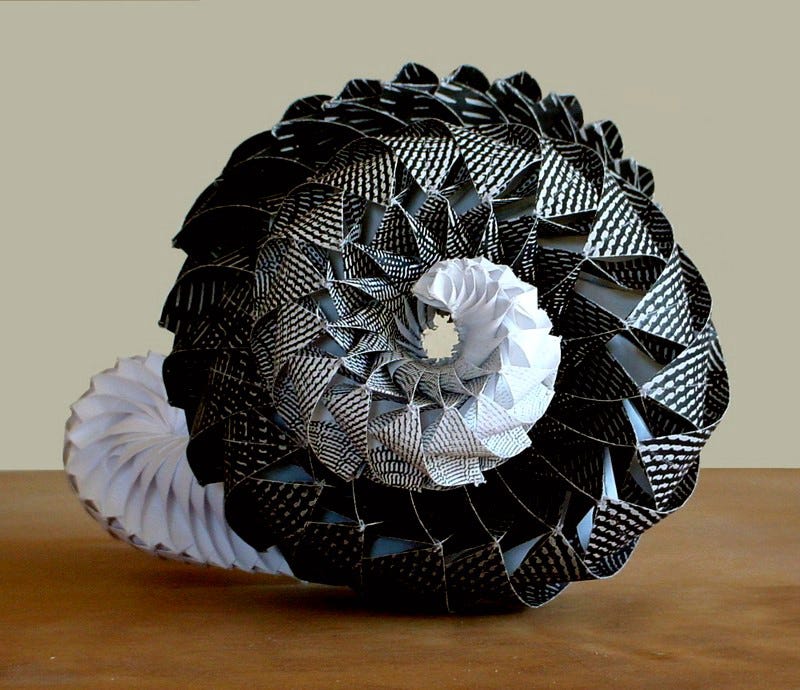


Bradford Hansen - Smith, dedicated a decade to studying geometry and its applications, realizing the profound nature of the circle as more than a mere shape. To him, the circle represented something greater—an embodiment of its internal essence. Through the act of folding circles, he discovered a spiritual quality in what he termed "Wholemovement." This philosophy viewed the circle as the fundamental source of all shapes in the universe, symbolizing the unity of the Creator. Remarkably, his exploration yielded astonishing results, transforming simple paper plates into beautiful geometric patterns. Instead of cutting the circle, he emphasizes the creation of intricate, defined designs through the initial folding process. While replicating his intricate craftsmanship may be challenging, anyone can create basic shapes. As a result, Bradford has conducted numerous workshops both nationally and internationally, emphasizing that "Wholemovement" is not a personal claim but a dynamic process that thrives through action.
HAQ-NI: What is your thought process when you are creating?
When I am most productive is when I can keep my thinking to a minimum and just allow the information to tell me what my choices are, then I go with those of most interest to me. This is not about creating as much as having a conjoint relationship with the circle. I do the folding using information the circle gives me, then take direction from the choices available at any given time in the process. This is similar to an artist that strives to understands the medium and material they are working with to then allow greater freedom for the unexpected potential to emerge.
HAQ-NI: Where do you usually work on your projects?
I typically work in small apartments, utilizing the space where I reside. Wherever I go, I carry a paper circle with me, allowing me to work anywhere. Through my experience, I've discovered that employing the circle's proportional movements when folding any piece of paper yields the same results as folding an actual circle. Thus, starting with a circle is not essential to achieve its folding pattern. Folding circles can be practiced anytime, anywhere, using any piece of paper. This accessibility enables anyone, at any moment, to explore mathematics, geometry, create beautiful forms, and expand ideas through the art of circle folding. In essence, I fold circles wherever I happen to be.
HAQ-NI: Who are/were your mentors?
Buckminster Fuller inspired me to adopt a fresh perspective on circles. Having a mentor who possesses the knowledge you seek is beneficial. However, since there aren't many individuals folding circles, I rely solely on my own experiences for learning. I have grown to appreciate this aspect. Perhaps I can encourage others to approach things from their own unique perspectives, acknowledging the value of their individual experiences.
HAQ-NI: Can you describe the evolution of your work?
As an artist, I always drew pictures in an effort to understand the nature of things. Through creating models, I gained deeper insights. For two decades, I worked as a sculptor before feeling the need to delve further into comprehending spatial relationships. Attending a class by Hazel Larsen Archer on R. Buckminster Fuller's geometry shifted my perspective, revealing patterns in a new light. Over the next ten years, I delved into geometry, seeking personal understanding of Fuller's teachings.
It dawned on me that the sphere holds the essence of all our knowledge in geometry, mathematics, and more. Traditionally, slicing the sphere in half and representing it as a flat great circle destroys its spherical unity, reducing it to a unit circle on a plane. However, by compressing the sphere into a circular disk, it retains its spherical wholeness while undergoing transformative changes without destruction. Through folding the circle, spherical information is simultaneously decompressed, merging 2D and 3D elements in dynamic patterns with each fold. I continue to be amazed by the profound breadth and depth of knowledge revealed through the act of folding circles.
HAQ-NI: Which of your projects has given you the most satisfaction?
My sole project that brings me fulfillment involves sharing my journey of folding circles with children, teachers, and parents. This aspect has always been integral to my process. Each individual has their unique experience with circles, and through interactions with students, I constantly discover new perspectives and learn from their creative approaches to folding. Engaging with people of all ages, even for brief periods, holds significant value in my exploration. It brings a sense of balance to my predominantly solitary work.
HAQ-NI: How would you describe your sense of fashion or the style? And did you have any style icons growing up?
I lacked a style icon in my youth, and that remains unchanged. I perceive fashion trends as fleeting, not leaving room for profound exploration. I view style as a collective agreement, representing community acceptance, while also allowing individuals to express their distinctiveness within a group. It serves as a means to visually manifest our inherent uniqueness and allow others to perceive us. Fashion represents the conformity of desired appearance, whereas style reflects the individual ego's presentation within the current fashion context.
HAQ-NI: Which part of the day is considered the most favorable or optimal?
I find myself more mentally alert and receptive during the morning hours, whereas my focus tends to diminish as the night progresses. During nighttime, there seem to be fewer restrictions or limitations on tasks or activities, which may either be disregarded or pursued further for enhanced clarity when approached in the morning.
This interview has been edited for brevity.
Subscribe to:
Posts (Atom)